
Custom Stainless Steel Jewelry: PVD Plating and Minimums
The stainless steel line publishes its own numbers, and they are not the silver line's numbers. On this page the Low MOQ is 100–150 pcs by style, 3D CAD lands inside 48 hours, and the custom sample window runs 25–35 days. Two grades are offered — 316L and 304 — and both are finished with PVD vacuum plating rather than a precious-metal electroplate.

Key takeaways
- Low MOQ on the stainless steel page is 100–150 pcs depending on the style, not a single fixed figure.
- 3D CAD is quoted at under 48 hours, and the custom sample window is 25–35 days on this line.
- 316L carries 2–3% molybdenum, is 100% waterproof and takes PVD with optimal adhesion.
- 304 is water-resistant for daily wear, nickel and lead safe, with reliable PVD adhesion and a cost-effective position.
Why the steel minimum is quoted as a range
Most lines publish one number and stop. This one states 100–150 pcs by style, which is more honest: a simple band and a multi-part pendant with a clasp do not consume the same bench time, so the quantity that makes a run viable moves with the design. Budget the upper end and treat the lower end as a reward for a simple shape.
That range is the reason steel is usually a second-line material rather than an opening one. Compare it with the silver figures on the same site — 50 pcs per design for 925 sterling silver and 100 for artisan eco-brass — and the steel band is clearly the heaviest commitment of the three.
316L and 304 are not interchangeable
The page covers both grades, and the difference is chemical rather than cosmetic. 316L contains 2–3% molybdenum, which is what gives it superior corrosion resistance against salt and sweat; it is described as 100% waterproof, shower-safe, sweatproof and swim-proof, medical-grade hypoallergenic, and it takes PVD with optimal adhesion. It is positioned as the premium tier for designer and waterproof lines.
304 is the volume grade. Corrosion resistance is high for daily wear, water resistance covers normal daily conditions, it is nickel and lead safe, and PVD adhesion is described as reliable. It is the cost-effective choice for high-volume wholesale, fast fashion and promotional programmes.
| Attribute | 316L | 304 |
|---|---|---|
| Molybdenum content | 2–3% | Not stated as a molybdenum grade |
| Water exposure | 100% waterproof: shower, sweat and swim safe | Water-resistant in daily conditions |
| Skin suitability | Medical-grade hypoallergenic | Nickel and lead safe |
| PVD adhesion | Optimal | Reliable |
| Best fit | Premium and waterproof lines | Volume, fashion and promotional runs |
What PVD vacuum plating does on steel
PVD is a vacuum coating process, and on stainless steel it is the published finish route instead of the multi-layer gold or rhodium electroplating used on silver and brass. Nothing here receives the anti-tarnish e-coating that the silver and brass orders carry, because there is no silver or copper surface to protect from tarnish.
The grade decides how well the coating holds. Optimal adhesion belongs to 316L, reliable adhesion to 304, and that is the practical difference a designer will notice over a season of wear: not the colour on day one, but the colour after a few hundred trips through a sink.
The three windows on the steel page
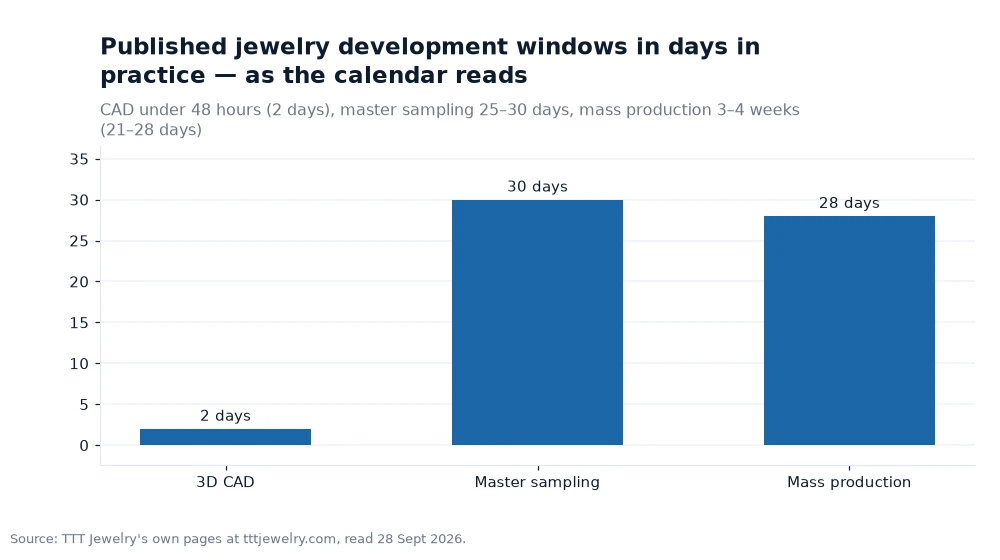
The timings published for this line are 3D CAD under 48 hours, custom sampling at 25–35 days, and production on the factory's standard mass-production block. The sample window is wider than the silver line's because steel is harder to machine and finish, and a first article in this material is a genuine tooling exercise rather than a formality.
Plan the calendar off these numbers and not off the silver page. A brand quoting its own launch date from the wrong page is the origin story of most missed deadlines, and the two sets of figures are only a few days apart until they compound.
Worked example: costing a two-grade range
Say the plan is a waterproof hero piece in 316L and a lower-priced companion in 304. At a Low MOQ of 100–150 pcs by style, two styles means 2 × 100 = 200 pieces at the floor and 2 × 150 = 300 at the ceiling, so the opening order sits in a 200–300 piece band depending on how complex each shape is.
Put the same band against the sample window: 25 days is 25 × 24 = 600 hours and 35 days is 35 × 24 = 840 hours. The 48-hour CAD stage is 48 ÷ 840 = 5.7% of the longer window and 48 ÷ 600 = 8% of the shorter one, so the drawing turnaround is a rounding error next to the bench work. The published figures are the manufacturer's; the multiplications are mine.
Picking a grade before you pick a plating colour
Choose the grade first, because it decides the water story and the coating adhesion, and only then choose the finish. A 316L piece sold as swim-proof justifies a higher retail price than the same shape in 304, while a promotional run priced to move at volume belongs in 304 with a straightforward colour.
A stainless steel jewelry manufacturer will also tell you where the grade decision lands in the drawing, which is early. The engraving options survive the decision either way: laser engraving is a published service, so a brand mark or a 316L stamp can be placed on an inner band or a clasp in the same pass.
What the steel page does not publish
Two things are deliberately missing from this line's published figures: a monthly capacity figure and a unit price. Neither appears anywhere on the site, and any supplier volunteering one is quoting from somewhere other than the client's own documentation. Plan quantity from the 100–150 pcs band and let price come from the specification.
The customization list is published, though, and it is broad: engraving, stamping, moulding and PVD plating are all named as steel-friendly processes, alongside versatile design options and suitability for large-scale production. That breadth is what makes steel a workable base for a whole range rather than a single accessory.
For a B2B wholesale buyer, the practical checklist is short: confirm the grade, confirm the adhesion expectation, confirm the finish colour and confirm whether the piece is sold as water-resistant or waterproof. Those four answers define the product, and three of them are settled before the sample reaches a bench.
Frequently asked questions
What is the minimum order for stainless steel designs?
The stainless steel page publishes a Low MOQ of 100–150 pcs by style, so the exact figure depends on the design: a simple shape sits nearer the lower end and a multi-part piece nearer the upper end.
How long does a custom stainless steel sample take?
The window published for this line is 25–35 days for a custom sample, with 3D CAD modelling quoted at under 48 hours ahead of it.
Which grade should a waterproof collection use?
316L, which contains 2–3% molybdenum and is described as 100% waterproof, shower-safe, sweatproof and swim-proof with optimal PVD adhesion; 304 is water-resistant for daily wear and better suited to volume lines.
Briefing the steel line in one message
Send the shape references, the grade, the finish, the style count and the target date. Grade and style count are the two fields that decide the minimum band and the water claim, and neither can be corrected later without moving the tooling.
A workshop working from that brief can answer with a quantity band and a sampling date on the same day. If the range also needs a precious-metal piece, the silver line numbers are published separately, and the production steps behind both lines are identical.
The basis for every figure above — the 316L / 304 grade comparison together with the stainless PVD option, followed by a custom sample window of 25–35 days — is the supplier's own site over at tttjewelry.com (read 28 Sept 2026). Any conversion into other units is my own construction — the site supplies the inputs only[1].