
Receipts for a One-Machine Mine: Bookkeeping That Survives a Tax Review
A single miner at 414 TH/s produces a small, steady trickle of coins: about 0.00018572 BTC a day, which is $15.73 gross at $84,692 and $15.10 after the listed 4% on the block-reward component. Over a year that is a real amount of money and a real amount of paperwork. The difference between a tidy return and an evening of guesswork is decided months earlier, by what was saved.
Key takeaways
- 414 TH/s credits 0.00018572 BTC a day, so a year of continuous running is about 0.0678 BTC.
- Save the pool statement monthly; a dashboard screenshot loses the timestamps that matter.
- Convert with one documented rate per period, not with whichever price is convenient.
- Keep the power invoices in the same folder as the mining statements.
The record you need is not the one the app shows
An app is built for the present tense. It shows the current hashrate, the balance and the shape of the last few days. That is the right tool for running a machine and the wrong tool for explaining a year, because the screens it displays are rolling windows that eventually forget the months you need.
A statement is different. It fixes a period, lists the credits inside it and does not change when the view is reopened in March. If the pool offers a downloadable history, take it at the end of every month even when nothing interesting happened. Thirty seconds of housekeeping prevents the reconstruction problem that appears when a return is due.
The two artifacts answer different questions, and a miner needs both. Use the app to decide whether the machine is healthy today. Use the saved statements to say what it earned last quarter.
One rate, written down, per period
Coins are the fact; dollars are an opinion about a moment. If a year's credits are converted at a dozen different prices because that is what the screen showed on each occasion, the total becomes impossible to reproduce and easy to challenge. Pick a published rate for each period, write down the source and the date, and apply it uniformly.
Monthly is usually the right granularity for a small operation. Daily is more precise and more work than the sums justify; annual is simpler and hides the price swings that a reviewer may want to see. Whatever the choice, the rule matters more than the interval: the same rule applied every month is defensible even if a different rule would also have been defensible.
Record the rate in the file name or the first row of the sheet. Six months later, "the December rate" is a memory; "84,692 on 21 December, from the exchange close" is a citation.
A folder an accountant can walk through
One folder per year, one subfolder per month, and inside it three things: the pool statement, the electricity invoices and a one-page summary. That structure is boring, which is the point. A reviewer who can find December's statement in ten seconds is a reviewer who finishes early.
Name files with the date first so they sort correctly: 2026-12-statement.csv, not statement-dec-final-v2.csv. Version names are for drafts; the saved statement should never have a draft.
The one-page summary carries the monthly BTC credited, the conversion rate used, the dollar value and the power cost. Four columns and twelve rows. Everything else in the folder exists to support those numbers, and the summary is what makes the folder usable by someone who did not build it.
| Week | BTC credited | Cumulative BTC | USD at $84,692 |
|---|---|---|---|
| 1 | 0.00130004 | 0.00130004 | $110.10 |
| 2 | 0.00130004 | 0.00260008 | $220.21 |
| 3 | 0.00130004 | 0.00390012 | $330.31 |
| 4 | 0.00130004 | 0.00520016 | $440.41 |
Four equal rows look suspiciously neat, and they are: they assume no downtime and no difficulty change. The real record will have a short week when a fan failed. Keep the assumption visible in the caption so that a later reader does not mistake a plan for a measurement.
Worked example
Build the annual figure from the daily one, then check it against the four-week table.
- Scale against the network: 414 ÷ 1,003,107,267 = 4.12718e-7.
- Applied to 450 BTC a day: 4.12718e-7 × 450 = 0.00018572 BTC.
- One week: 7 × 0.00018572 = 0.00130004 BTC, worth $110.10 at $84,692.
- One month of 30 days: 30 × 0.00018572 = 0.00557160 BTC, or $471.87.
- One year of 365 days: 365 × 0.00018572 = 0.06778780 BTC, or $5,740.79.
- With the listed 4% removed from the reward portion: 15.73 × 0.96 = $15.10 a day, $5,511.16 a year.
- Four units at 1.656 PH/s: 0.00074295 BTC a day, $62.92 gross and $60.40 net; ten units at 4.14 PH/s: 0.00185743 BTC, $157.29 gross and $151.00 net.
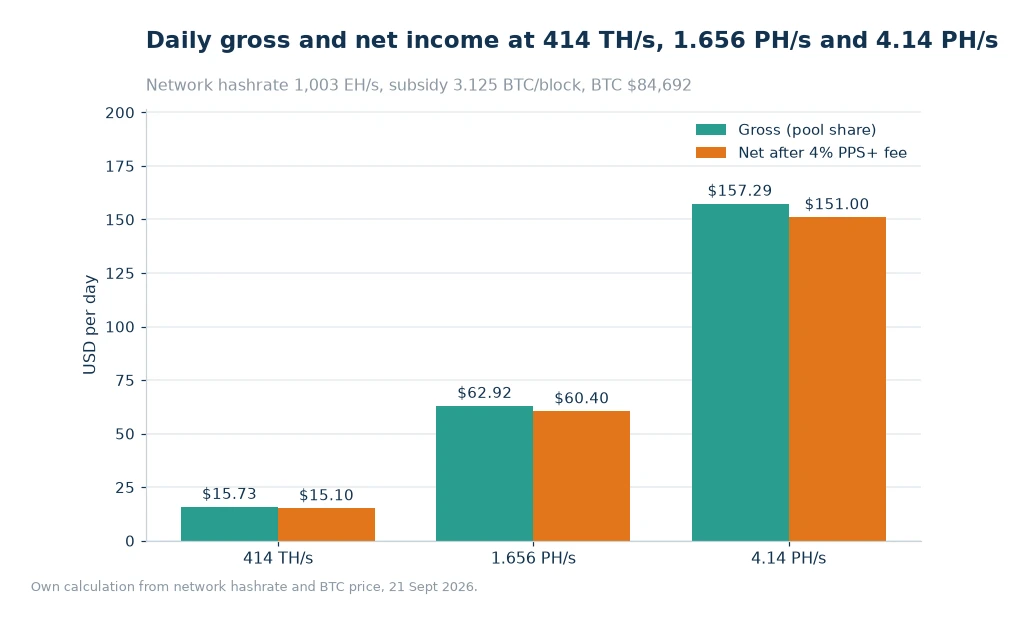
The Statistics page is a useful cross-check on a low month, because it separates a network change from a machine that quietly stopped.
When a payment lands after the year closes
PPLNS balances can settle across a period boundary. A block found on the last evening of the month may confirm after the statement folder has been closed, and the credit will appear in the next month's file. That is normal, and it should be noted rather than argued with.
Add one line to the summary: "Payments received in this month for work performed earlier." It costs nothing and it explains the small irregularity that would otherwise look like an error. Miners who use PPS+ see this less often, because the hourly credit leaves little room for a cross-period settlement.
Do not retroactively edit a closed month. Keep the original file and put the correction in the following month's summary with a note. An audit trail with visible corrections is stronger than a spotless file that cannot be reproduced.
Keeping the app in the loop without trusting it blindly
Use the phone for its real strength: noticing. A hashrate drop or a stale share timestamp on a Tuesday afternoon is worth acting on immediately, and the app is the fastest way to see it. Just do not let the phone become the archive. Notifications disappear, and so do the sessions that produced them.
The multi-currency wallet inside the same account is where the coins actually land, and its history is a second, independent record. Comparing wallet inflows with pool statements catches the rare case of a credit that was generated but never arrived.
Install the ViaBTC App Download build on the phone you keep for admin tasks, not the one you use at the dinner table. The point is to keep the alerts and the records close to each other without mixing them into a personal device that gets replaced every two years.
Frequently asked questions
How much does a 414 TH/s miner earn in a year?
About 0.06778780 BTC at the reference hashrate, which is $5,740.79 gross at $84,692, or roughly $5,511 net after the listed 4% on the block-reward component.
Should mining records be kept in BTC or dollars?
Keep the BTC figure as the primary fact, then convert once per period at a documented rate, so the dollars can be reproduced later without relying on memory.
What if a payout arrives after the month is closed?
Leave the closed file untouched and note the late credit in the next month's summary, which keeps the record honest and still traceable.
Close the month while it is still fresh
The work takes less time than reading about it. Download the statement, drop it in the month's folder, add the power invoice, and write the four columns. Then check the total against the wallet and put the file away.
Do it on the first of the month, before the previous month becomes a vague memory. The Profit Calculator is useful here as a sanity check: if your recorded output is far from what the calculator implies for your hashrate, either the machine was down longer than you thought or a statement is missing.
Sources: ViaBTC wallet, calculator and app pages for statements, conversion and monitoring[1]. Annual arithmetic uses 21 Sept 2026 inputs: 450 BTC a day from 1,003 EH/s at 132.76 T, with the coin at $84,692. Published 24 Oct 2026; 365 uninterrupted days assumed.